
Colorado producers and ag professionals spent a day testing whether CCPC’s developing Research AI can turn trusted corn research into answers that are accurate, clear and useful on the farm.
Finding and accessing the right research is not always easy. Even when good information exists, it may be buried in a long report, written in technical language or difficult to connect to a specific production decision.
That is the problem the Colorado Corn Promotion Council (CCPC) and Colorado State University (CSU) are trying to address with the CCPC Research AI. The developing tool is a closed artificial intelligence system loaded with vetted corn research rather than information pulled broadly from the open internet. The goal is to give producers a faster way to ask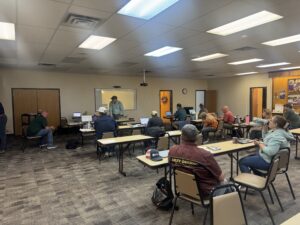 practical questions and receive answers supported by trusted sources they can review themselves.
The tool is built on foundational work by Dr. Perry Cabot, Dr. Todd Ballard and Holly Stanley to make corn research more accessible and useful to producers. Their work helped establish the research library behind the tool, explore how artificial intelligence could translate technical research into more practical information, and put producer feedback at the center of evaluating whether those answers are accurate and useful.
On September 3, CCPC hosted a full-day producer focus group in Greeley, bringing together corn producers and agricultural professionals to put the developing system to the test.
The workshop was led by Dr. Perry Cabot, with support from Dr. Todd Ballard, Ian O’Banion and Deeptanshu Sankhwar.
Throughout the day, participants tested the Research AI with real-world questions, beginning with topics they knew well and moving into areas where they were less familiar. This allowed producers to judge not only whether the answers were accurate, but whether they were clear, useful and backed by the right research.
The emphasis was not simply on whether the technology worked. It was on whether producers would actually trust and use the information it provided. Participants scored responses, checked citations and shared feedback on where the system was helpful, where it fell short and what would make it more useful in practice.
Key Takeaways from the Discussion:
Early feedback pointed to several encouraging strengths. Participants generally found the tool easy to use, valued being able to see the research behind each answer and said citations increased their confidence in the information. Keeping responses tied to a vetted research library also helped build trust.
Participants saw value in broadening the scope of the tool’s research library and making it more of a “living library” that incorporates current, relevant information, including more location-specific resources and topics that influence real-world farm decisions.
The feedback also reinforced an important benchmark for future development: the tool needs to become consistently more useful than the ways producers already find answers, whether through Extension, an agronomist, Google or other trusted resources.
CCPC and CSU will use this feedback to improve the system, expand the research behind it and continue putting new versions in front of producers.
Want to test the next version or suggest research for the library? Producers and industry professionals interested in future testing sessions or providing feedback can contact Ian O’Banion, CCPC Research Manager, for upcoming opportunities.